Trailering 101
Part III: A Word About Goosenecks
Disclaimer: Please refer to the manuals of
tow vehicle, trailer and hitch for recommended operating procedures and
limitations before use and/or purchase.
This is the third article in a series related to educating
our readers on vehicles, hitches and trailer compatibility. Part I: What Can
My Vehicle Tow? and Part II: And Now The Hitch. are still on line for your
convenience.
This month we are going to cover goosenecks. The first
item of business is to clear up a common misconception that: A "fifth wheel"
and a "gooseneck" are one in the same. They are not. Yes both
types of trailer hook into the bed of the truck, but the actually
connections are different. When asking about hitch installation using the
incorrect terminology can present problems.
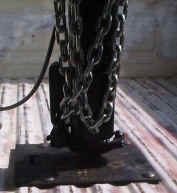 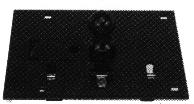 The
first picture to the left The
first picture to the left
shows a trailer attached to a
"Gooseneck hitch", the
second is a close up of the
hitch plate itself. This plate
or something like it, is normally
visible on the top of the truck bed. Underneath the bed are
supporting rails that are usually welded into place, and serve as
the actual support structure for the hitch assembly. For the most
part, there are two configurations for a gooseneck hitch, hide
away as shown above or one which remains upright at all times. The
hide away, which is becoming pretty much standard these days, when not in
use folds down into the bed of the truck, once again making it useful for
things like hay and plywood. The other as indicated just stays upright
in the middle of the bed at all times. (Note: the trailer at left is not
totally connected, before moving a trailer make sure all safety equipment is
connected per manufacturer's recommendations).
 Now
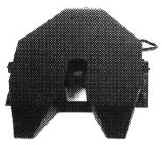
for the fifth wheel. This is a fifth wheel hitch. As you can Now
for the fifth wheel. This is a fifth wheel hitch. As you can
see there is no ball. We apologize for not being able to show you
the matching trailer end but basically as opposed to having a
couplerwhich accepts a ball hitch, the trailer has, for lack of a better
word, a disc on the end of the coupler which slides into the hitch
shown at left. Most horse trailers you will find come standard
with
the "gooseneck hitch" as in the previous section. However, most
trailer manufacturers will offer a fifth wheel attachment or coupler
as an option. You may ask which is better, we can't answer that
question. If you are going to haul a really big trailer you may wish to
speak with your manufacturer and hitch installer to see if one coupler has
benefits over the other. Like weight carrying capabilities etc...
2) Hitch Installation. We are not going to
address this issue to much accept to say that most "gooseneck hitches" are
installed anywhere from 2" to 6" in front of the back axle.
Installation directly on or behind the back axle is usually not recommended
for handling and stability purposes.
3) Trailer Towing Height. Just like bumper
pulls goosenecks too have a recommended tow height. Just like bumper
pulls they should be riding level to just slightly nose high and never down.
Exaggerated attitudes in either direction can place more stress/weight than
intended on the axles and cause driving instability. Unlike the bumper pull
where the hitch was adjusted to accommodate height, in this case it is the
neck of the trailer itself which is adjustable. Most goosenecks are
equipped with two vary large self taping bolts which when loosened allow the
inner portion of the coupler to move allowing you to raise or lower the
neck/trailer height. (more about this in item#6)
4) Vehicle Capabilities. Make sure that if you have
or intend to purchase a truck for use with a gooseneck that you check your
trucks towing capacities. Make sure that the GVW of the trailer
you are towing falls within the capabilities of your truck and that there
are no restrictions against hauling a gooseneck.
5) King Pin Load. This refers to the amount of weight
your truck can handle in its bed, or on the gooseneck hitch. Different
gooseneck trailers apply differing amounts or percentages of weight to this
area. Usually this amount is dictated, first of course by the size of
trailer and intended load, but secondly by the placement of the axles on the
trailer. The farther back the heavier the load. Some of
the larger head-to-heads and living quarters can have as much as 20-35% of
the load placed on the hitch, smaller trailers can be as little as 900-1000
lbs. In any case, check with the trailer, truck, and hitch
manufacturers/installers to make sure all components are compatible.
6) Truck Bed Length & Height. Both of these
have become issues since 4WD shortbeds are so common place.
Lets tackle bed length first. Most folks prefer a shorter bed
especially when going to a super or crew cab truck due to length
considerations. That is okay except, if a gooseneck is in your future
keep in mind you may be limiting your trailer selection. The
problem comes in the area of "turning". For a typical full nosed
gooseneck depending on the interior width the trailer may hit the back of
the cab or only clear by inches. Either case is not very comfortable.
Just keep in mind that if you have a truck bed less than 8' you must shop
wisely for a trailer. We strongly recommend "test driving or turning"
before you buy. Also, where your hitch is installed may help to give
you a little more maneuvering room, but again we do not recommend going on
or behind the back axle. Now with any gooseneck you can turn far
enough to hit the cab but it would be nice to at least get close to 80-90
degrees before encountering problems. One other note, there are some
"fifth wheel" hitches which have releases on them so that you can move the
trailer back from the cab when maneuvering in tight spots like gas stations.
Once you make the corner you lock it back into towing position. This
type of apparatus is used quite often with travel trailers.
Now for height. Most manufacturers over the years
have made adjustments to their trailers to accommodate the higher beds.
As we discussed trailer towing heights in #4, there is only so much you can
do with the actual trailer neck/coupler to compensate for a high truck bed
and still stay within the recommended towing height. The changes that
had to be made for the trailers were in the trailer bulkhead itself.
They had to make the height from the trailer floor to where the neck started
taller. In this way, they could clear the bed rails of the truck and
still maintain a level towing height. However, we do want to point on
that in the '99 model years of some trucks the bed heights have increased
again! In one case as many as 3" to 4". Usually this becomes an issue with
the 4 wds. We pointed this out because if you have a new 4WD and are
considering an older trailer again shop wisely, not all trailers will be
appropriate. In fact it wouldn't hurt to check this out even if you
are buying a new one.
Well that's it for this month. We did not have time to
do the electrical system justice so we will get to it next time.
Happy Trailering... See you Next Month. (Or whenever
we feel like something needs to be said.)
If you have any comments, suggestions
or topics for a "Trailering 101" article we'd be happy to take them.
Trailering education is our goal.
|