Trailering
101
Part IV: Electrical Plugs and...
Disclaimer: Please refer to the manuals of
tow vehicle, trailer and hitch for recommended operating procedures and
limitations before use and/or purchase.
This is the fourth article in a series related to
educating our readers on vehicles, hitches and trailer compatibility. Part
I: What Can My Vehicle Tow? , Part II: And Now The Hitch., and
PART III: A Word About Goosenecks are still on line for your
convenience.
One of the last pieces we need to cover is the electrical
hook up. Most horse trailers require wires for the following
elements, left stop & turn, right stop & turn, running lights, ground and
the majority of horse trailers also require a hot lead tied into a brake
controller in order to operate the electric brakes on the trailer and...?
The reason we ended the statement that way is because beyond those listed
items we find that most horse trailers vary. For example, some have
back up lights, auxiliary hot leads to operate interior lights separate from
your car running lights, trickle chargers for brake away batteries,etc...
Most horse trailer come with a wiring diagram for purposes of installing the
electrical connections. What we are going to go through this
month is not so much the actual wiring aspect of trailers but the physical
connectors. And, keep in mind this is just a sampling.
 |
1)Known as a flat four this type
of connector is generally used for boat trailers, and small utility
trailers which do not use electric brakes. The name comes from the fact
that they only have a 4 wire limitation. Because of this, they are not
capable of handling most horse trailers, except those with inertia or
surge brakes. |
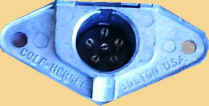 |
2)
6-Pin Round.
This type of
connector is the matching endfound on most horse trailers due to its
ability to handle 6 wires or connections. Depending on how your trailer
is wired it may employee 5 or all 6 of the pins available. One
application which may use up all 6 pins is if your trailer has back up
lights. |
 |
3) 6-Pin Round trailer
connector. This is the matching or trailer end to item #2
above. |
 |
4) 7-Pin Round connector. Again
this is the end which would be installed on the vehicle. This connector
even though it can be used for bumper pulls is more commonly found on
goosenecks. The extra pins allow more wires and therefore more
flexibility in the way lights and other auxiliary equipment can be
operated. |

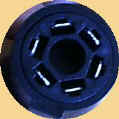 |
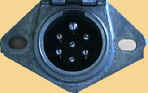
5) 7 to 6 Adapter.
The pictures to the left show both ends of this adapter. We have found
that many vehicleswhich come with factory installed plugs have the
connectors typically associated with travel trailers and not horse
trailers.We apologize for not having a picture of the matching end but
it would plug into the picture on the right and convert it so that you
could plug it into the a trailer with a connector as in item#3. There
are many adapters available on the market so that you may not need more
than one electrical hook up on the back of your vehicle. We must admit
however, we have had 50/50 luck with these adapters, it all depends on
how the initial wiring was accomplished and how many items your trailer
has. |
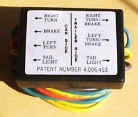 |
6) Electrical Converter. Even
though most folks will never see this
box installed in their vehicle, except maybe on the bill, this is
required for vehicles which have separate Amber turn and Red stop
indicators. It combines these two electrical pulses, if you will, and
combines them on the same line so that the trailer stop & turn lights
will function properly. |
7) Brake Controller, or Black box.
This is required for all trailers which have electric braking systems.
Even if your vehicle is factory "pre-wired" for a trailer usually this item
has to be added. It is the box which ties in your vehicle braking
system to the brake system on the trailer allowing them to work in unison.
Well that's it for this month. Look for future articles on informative
trailering websites. We are going to try and search out some of the
best, if you have ideas for this we would like to see them. After all
"trailering education" really is our goal.
Happy Trailering... See you Next Month. (Or whenever
we feel like something needs to be said.)
If you have any comments, suggestions or topics for a "Trailering 101"
article we'd be happy to take them. Trailering education is our goal.
|